Monday, January 23, 2012

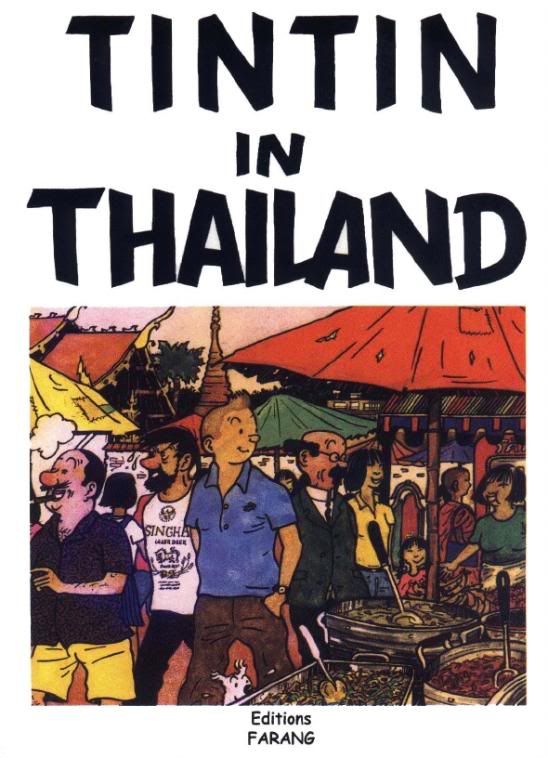
26. Tintin in Thailand (By Bud E. Weyser)


Tintin in Thailand is a parody of the The Adventures of Tintin books by Hergé, released in 1999. It is written and designed to emulate a volume of the Tintin books, but is the author's own story. It was deemed to have violated copyright laws and thus its publication is illegal.

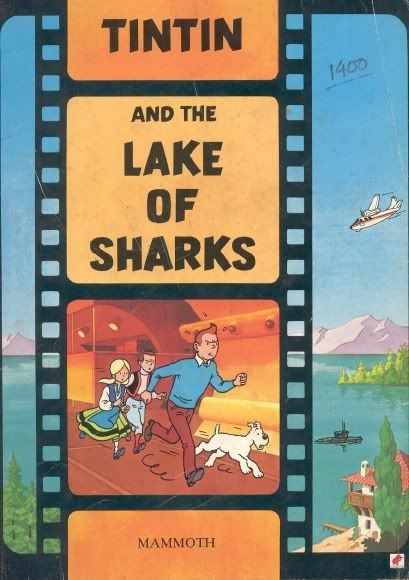
25. Tintin and the Lake of Sharks (1972) [By Greg]


Tintin and the Lake of Sharks (originally known as Tintin et le Lac aux Requins) is a comics from theTintin animated film, directed by Raymond LeBlanc (1972). It was not written by Hergé, who supervised, but by the Belgian comics creator Greg (Michel Regnier), a friend of Hergé. It was later adapted into a comic book in which the illustrations were drawn to look like still images from the film.
Tintin, Snowy, Captain Haddock and Thompson and Thomson head out to Cuthbert Calculus' estate on a mysterious lake in Syldavia. They end up discovering a large criminal gang in a base on the bottom of the lake ruled by Tintin's old enemy Rastapopoulos, who goes under the name of 'King Shark'. Calculus has invented a machine which can reproduce objects in three dimensions, which Rastapopoulos tries to steal to use in an art forgery racket. He tries to drown Tintin, but Tintin escapes. Rastapopoulos is apprehended by Tintin and Haddock.

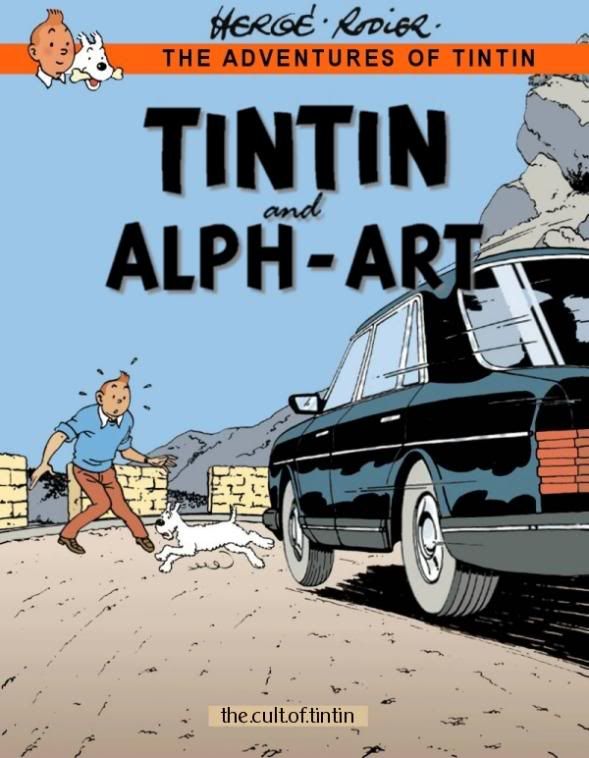
24. Tintin and Alph-Art (1986-2004) [By Hergé, Completed By Rechard & Rodeir]


Tintin and Alph-Art (French: Tintin et l'alph-art) is the twenty-fourth and final book in the Tintin series. It is a striking departure from the earlier books in tone and subject, as well as in some parts of the style, due to Hergé having lost interest in telling more stories in the mold of his earlier 'Tintin'-books.
Hergé worked on the book until his death in 1983, and it was published posthumously (despite its unfinished status) in 1986 by Casterman in association with La Fondation Hergé, and was republished in 2004 with further material.

In 1976, a few months after the publication of Tintin and the Picaros, Hergé told the journalist and author Numa Sadoul that he was contemplating the next adventure of Tintin — setting an entire story in an airport departure lounge. This idea was eventually dropped, and in 1978, he decided to set the story in the world of modern art. He had grown tired of his creation, and the pressure he was under to produce new adventures, and in an attempt to rekindle his passion for writing and drawing the adventures of Tintin, chose to incorporate his love of avant-garde artwork into the new story. Hergé was inspired by the Ferdinand Legros and Elmyr de Hory affair, and incorporated a second element, anew age sect and a phoney guru. He planned to cast Rastapopoulos as the villain, but according to Harry Thompson, dropped the idea in 1980 when he introduced the alphabet art element.
The story opens with Captain Haddock having a nightmare of being visited by Bianca Castafiore, who demands that he take his "medicine" (a bottle of Loch Lomond). When he refuses, as he still cannot stand it after the events of the previous book, Castafiore turns into a huge bird-like creature which then attacks Haddock. Fortunately Tintin manages to wake him up, and then receives a telephone call from the real Castafiore, telling him that she is in Belgium for a few days, and tells him about the man she is with, Endaddine Akass, a famous mystic. In town, Captain Haddock comes across Castafiore, and to avoid her, dashes into the nearby Fourcart Gallery, meeting avant-garde artist Ramó Nash and owner of the gallery, Henri Fourcart. Fourcart shows an interest in meeting Tintin. Haddock purchases a perspex letter 'H' (Personalph-Art). Back at Marlinspike, Haddock and Tintin watch a news report about their old friend Emir Ben Kalish Ezab, who plans to buy Windsor Castle from the British government, and the Beaubourg Centre (the Pompidou). Following this is a report on the suspicious death of art expert Jacques Monastir, who is presumed drowned off the coast of Ajaccio.

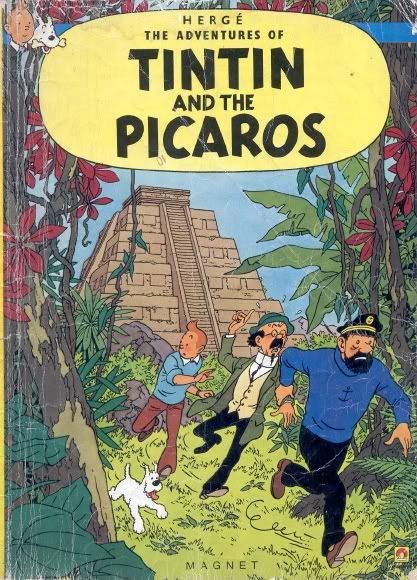
23. Tintin and the Picaros (1976)


Tintin et les Picaros is the twenty-third and final completed book in the series. It caused the most controversy of the Tintin stories since the first two (Tintin in the Land of the Soviets and Tintin in the Congo), although the controversies were aesthetic rather than political: Tintin no longer enjoys adventuring and has abandoned his trademark plus fours; Captain Haddock can no longer drink the Loch Lomond brand whisky; and General Alcazar's masculinity is ridiculed by his new dominant wife.

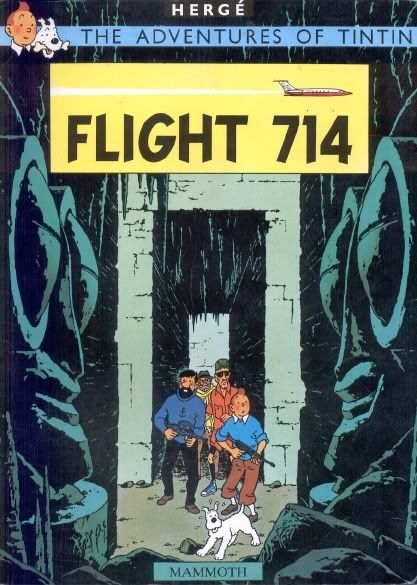
22. Flight 714 (1968)


Flight 714, first published in 1968, is the twenty-second of The Adventures of Tintin. Its original French title is Vol 714 pour Sydney ("Flight 714 to Sydney").
Tintin, Captain Haddock and Calculus are on their way to Sydney for an international conference on space exploration. While their flight makes a refueling stop in Jakarta's Kemayoran Airport, they unexpectedly meet their old friend Piotr Skut (see The Red Sea Sharks for back story), who is now the chief pilot for eccentric millionaire Laszlo Carreidas. A short time earlier, the Captain had erroneously taken the somewhat disheveled Carreidas for a tramp and surreptitiously slipped him a five-dollar bill (which later is taken by the oblivious Professor Calculus, making the millionaire laugh for the first time in years). When introduced to Carreidas, the Captain inadvertently shakes the hand of the millionaire's secretary, the tall, aloof Spalding.
Unable to politely refuse Carreidas's offer of a ride on his prototype private jet, Tintin and his friends join the millionaire on the way to Sydney. Carreidas plays Battleship with the Captain, defeating him repeatedly by cheating with a hidden closed-circuit television camera and monitor. Unbeknownst to Carreidas and the others, Spalding and two of the pilots, Boehm and Colombani, have been recruited to hijack the plane and bring it to a deserted island called Pulau-Pulau Bompa in the Celebes Sea. Skut is not involved in the plot, and so he becomes a prisoner too. After a rough landing, our friends are escorted out of the plane, and a terrified Snowy breaks out of Tintin's arms and runs off. Armed guards shoot at him, and a mortified Tintin takes him for dead.

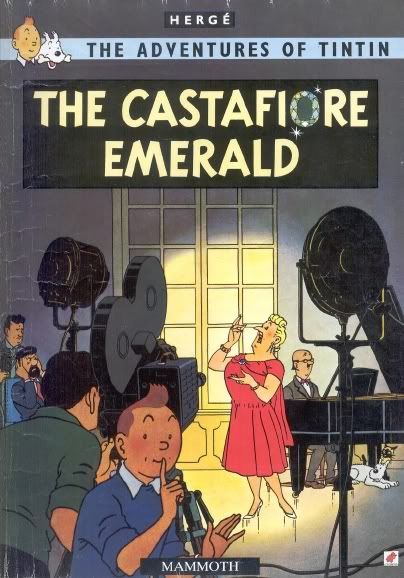
21. The Castafiore Emerald (1963)


The Castafiore Emerald (French: Les Bijoux de la Castafiore) is one of a series of classic comic-strip albums The Adventures of Tintin.
The Castafiore Emerald is the twenty-first in the series. The slowest-moving and most sedate of The Adventures of Tintin, it was conceived as a narrative exercise by Hergé. Becoming disillusioned with his most famous creation, the cartoonist wanted to see if he could maintain suspense throughout sixty-two pages in which nothing much happens.[1] Consequently it is a story without villains, guns or danger, but rich in comic setpieces, red herrings, mistaken interpretations, and colourful characters. In this sense, it has many similarities to a screwball comedy film.

Captain Haddock and Tintin are walking through the countryside when they come across a Romacommunity camped in a garbage dump. They investigate and upon learning that the community chose that site on account of being forbidden by the police to use any other location, the Captain invites them to his grounds of his estate, Marlinspike, over the objections of his butler Nestor.
Shortly afterwards, Bianca Castafiore, famous opera Diva and scourge of the Captain decides to invite herself to Marlinspike for a holiday. All manner of mayhem ensues. For some time, one of the marble steps leading to the foyer in Marlinspike Hall has had a plate-sized chip that Nestor has kept replacing while waiting for the repairman, who has been fobbing the Captain off. Upon hearing of Bianca's impending visit, Haddock rushes to pack for a trip to Italy, figuring that now would be a good time to visit that country, which he had always avoided precisely to avoid Bianca. In his haste Haddock misses the step, which, just moments before, he had been sanctimoniously warning Nestor and the others about. He sprains his ankle as a result. The doctor arrives, examines the Captain, and insists upon putting the foot and ankle in a cast while imposing a minimum of a fortnight's bedrest. As a result, the Captain remains confined to a wheelchair for all but the last couple of pages. The broken step becomes a running gag for the rest of the comic, and nearly every character, except Bianca, herself, slips and falls down the step at least once.

Sunday, January 22, 2012

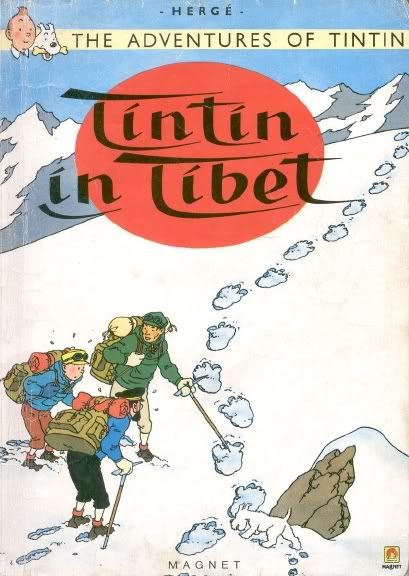
20. Tintin in Tibet (1960)


Tintin in Tibet (French: Tintin au Tibet) is one of The Adventures of Tintin.
Tintin in Tibet is the twentieth book in the series. It is said to have been Hergé's favourite of the Tintin series (previously The Secret of the Unicorn), and was written during a personally difficult time in his life, as he was divorcing with his first wife. The story is unlike any previous Tintin books, before or since: there are only a small number of characters and no enemies, villains, spies or gangters. This adventure revolves around a rescue mission.
It is also unusually emotional for a Tintin story: moments of strong emotion for the characters include Tintin's enduring belief in Chang's survival, the discovery of the teddy bear in the snow, Haddock's attempting to sacrifice himself to save Tintin, Tharkey's return, Tintin's discovery of Chang, and the yeti losing his only friend. Indeed Tintin is seen to cry when he believes Chang's fate, something he is only seen to do twice throughout the entire series (the other occurrence being in The Blue Lotus).
Whilst on holiday in a mountain resort with Captain Haddock and Professor Calculus, Tintin reads about a plane crash in the Gosain Than massif in the Himalayas. That evening at the hotel, Tintin dozes off while playing chess with the Captain, who is having trouble deciding on his next move. Tintin has a vivid dream that his young Chinese friend Chang Chong-Chen (see The Blue Lotus for back story) survived a plane crash, and awakes with a violent start, yelling "chang!" and throwing the whole recreation room into chaos. The next morning, he reads in the paper that it was Chang's plane that crashed in Tibet. Believing that his dream was a telepathic vision, Tintin travels to Kathmandu, followed by a skeptical Captain Haddock. They meet with a sherpa named Tharkey, and accompanied by some porters, they head to the crash site.